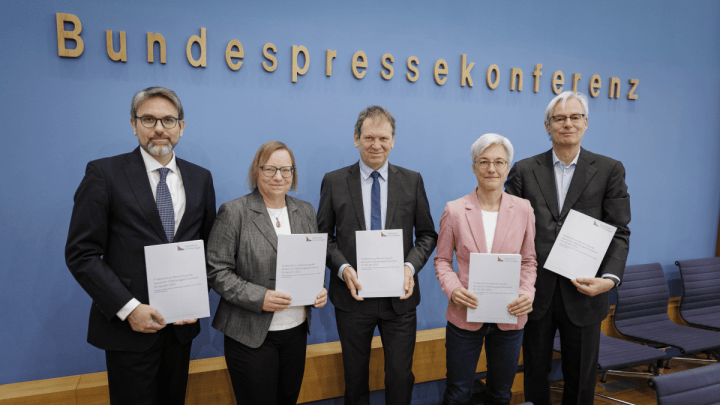
Today, the Council of Experts on Climate Change published its review report of the German greenhouse gas emissions for the Year 2024 and the projection data of 2025. EWI Director Marc Oliver Bettzüge is part of the five-member panel.
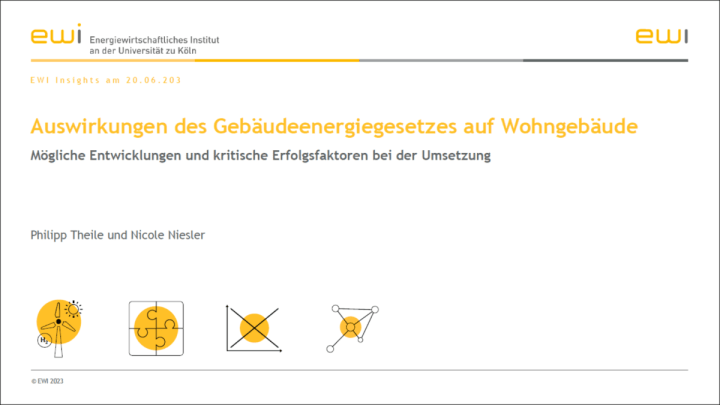
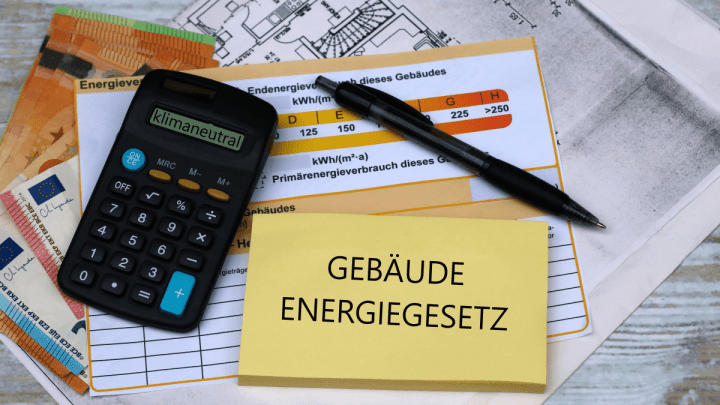
The EWI has analysed four energy policy proposals from the coalition agreement between the CDU, CSU and SPD: the reduction in electricity prices, the financing of renewable power plants, the expansion of the core grid and the Building Energy Act.
The European Emissions Trading System (ETS2), planned to start in 2027, could drive up CO₂ prices in the building and transport sectors. This would have distributional effects and increase the pressure on households to invest in climate-neutral technologies.
In the course of decarbonisation, a decline in demand for natural gas is expected in many European countries. A new working paper by researchers at the EMI shows that degressive depreciation of gas grids to be decommissioned is theoretically welfare-optimal.
EWI compared heating technologies in terms of emissions, infrastructure, and heating costs. The analysis considered both renovated and unrenovated building types, as well as the trade-off between costs and emissions.
Hydrogen is considered an important part of the EU’s and Germany’s climate neutrality strategy. Significant progress is required for the ramp-up, otherwise the targets might not be met. A report by CASSIS and EWI analyses the status of the ramp-up.
The latest edition of the EMI Insights online-event series focussed on flexibility in the electricity market. Two EWI researchers presented current analyses of the bidding zone split and the consequences of increasing price volatility.
Photovoltaic expansion and household batteries: New study examines the impact of time-varying electricity tariffs on household net-load profiles and the integration of renewable energies.
The recent Strommarkttreffen (Ger. electricity market meeting) on international electricity trade focused on efficient market coupling, cross-border capacities, and distributional issues. The event is part of an open network of energy experts.